How much does 1 gallon of epoxy resin cost
A gallon of epoxy resin typically costs between $40 and $150, but the final price depends on the type, brand, and where you buy it. With prices varying so widely, it's easy to feel overwhelmed when choosing the right product for your project. Are you paying for quality or just a brand name? What hidden costs should you budget for? And how do you avoid wasting money on the wrong resin? In this guide, we'll break down the price ranges, explain what drives the cost, and give you practical tips to get the best value for your epoxy resin. You'll also learn about unexpected expenses like wasted resin and finishing supplies, so you can plan a realistic budget from the start.
Key Takeaways
Epoxy resin costs $40 to $150 per gallon based on type and quality.
Match the resin type to your project thickness for best results and savings.
Budget extra for hardener and supplies; they add 20% to 50% to your total cost.
Buy in bulk only if you can use the resin before it expires.
Epoxy Resin Price Ranges: What to Expect
Tabletop and Coating Resin Costs
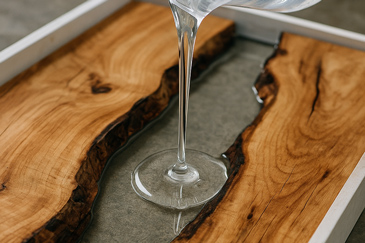
Tabletop resins serve a specific purpose. You use them for thin layers, typically 1/8 inch or less. These products cost between $50 and $100 per gallon. You can find budget options on Amazon for around $40. Premium brands may charge $150 or more. The price depends on clarity, UV resistance, and brand reputation.
Coverage matters more than the sticker price. A single gallon of tabletop resin covers a surprising amount of surface area when you spread it thin. At 1/32 inch thickness, one gallon covers roughly 31 square feet. At 1/16 inch, that number drops to about 15 square feet. For a standard 1/8-inch tabletop layer, you get only about 8 square feet per gallon. This means a typical 4-foot by 2-foot tabletop requires roughly one full gallon. The cost per project, therefore, depends heavily on your chosen thickness.
Thickness | Gallons per sq ft | Coverage per gallon |
|---|---|---|
1/32 in | 0.032 | ~31 ft² |
1/16 in | 0.065 | ~15 ft² |
1/8 in | 0.130 | ~8 ft² |
1/4 in | 0.260 | ~4 ft² |
You can work backward from this table. Start with your project area. Divide that number by the coverage per gallon at your desired thickness. The result tells you how many gallons you need. Multiply that by the price per gallon. That calculation gives you your true material cost.
Reverse Calculation Formula: Area (in²) = (fl oz × 1.80469) ÷ Thickness (in). Convert to ft² by dividing by 144.
This formula helps you plan precisely. For example, one gallon equals 128 fluid ounces. At 1/8 inch thickness, you calculate the area as (128 × 1.80469) ÷ 0.125, which equals roughly 1,848 square inches. Divide by 144 to get about 12.8 square feet. This matches the table's estimate closely.
Casting and Deep Pour Resin Costs
Deep pour resins serve a different purpose. You use them for river tables, paperweights, and thick encapsulation projects. These products cost more because they solve harder problems. The typical price per gallon ranges from $75 to $80, depending on kit size.
Kit Size | Total Price | Price per Gallon |
|---|---|---|
1.5-Gallon | $119.99 | $79.99 |
3-Gallon | $229.99 | $76.66 |
6-Gallon | $449.99 | $75.00 |
Several factors drive this higher price:
Advanced formulation: Deep pour epoxy includes specialized additives. These maintain clarity, reduce shrinkage, and prevent overheating during thick pours. Standard tabletop resins lack these features.
Slower, controlled curing: The extended cure time allows trapped air to escape. It also prevents heat buildup. This requires more complex chemical engineering and quality control.
Lower viscosity: A thinner liquid consistency enables flow into tight spaces. It also surrounds embedded objects completely. Precise formulation achieves this, adding to production costs.
Premium quality assurance: Lower-cost brands cut corners on raw materials and testing. Deep pour epoxies undergo strict quality control standards. Rigorous testing and higher-grade ingredients drive up the price.
You might wonder if the extra cost is worth it. For thin coatings, tabletop resin works perfectly. For thick pours, deep pour resin prevents cracking and clouding. Using the wrong type wastes money and produces poor results. A deep pour resin for a thin tabletop coat means paying for features you never use. A tabletop resin for a thick pour risks overheating and failure.
The price difference reflects real engineering. You pay for reliability, clarity, and safety. When you compare options, consider your project's thickness first. Then match the resin type to that requirement. This approach ensures you get the best value for your epoxy resin investment. The right choice saves you from costly mistakes and rework. Your project deserves the correct product from the start.
Why Epoxy Resin Prices Vary So Much
Quality, Viscosity, and UV Resistance
The price gap between budget and premium epoxy resin comes down to what manufacturers put inside the container. You might assume all resins perform the same, but the differences become obvious within months of use.
Factor | Budget Resin | Premium Resin |
|---|---|---|
UV Stabilizers | Minimal; yellows in 3-6 months | Advanced inhibitors; clear for 10+ years |
Raw Material Grade | Lower-grade industrial | Pharmaceutical-grade |
Manufacturing | Basic quality control | ISO-certified, batch-tested |
Formulation | Simple, for thin coatings | Complex, for deep pours with extended working time |
UV resistance alone explains a significant portion of the price difference. Budget formulations lack proper stabilizers, so sunlight turns them yellow within three to six months. Premium products use advanced inhibitors that maintain clarity for a decade or more. If your project sits near a window or outdoors, that longevity matters.
Viscosity also separates cheap from expensive options. Lower viscosity means the liquid flows more easily, penetrates small gaps, and releases trapped air bubbles during curing. Budget resins often have higher viscosity with more impurities, making them harder to work with and more prone to defects. Premium raw materials cost two to three times more, and that expense shows up in the final price.
Hardness provides another measurable difference. Budget formulations typically achieve Shore D ratings of 70-75 after curing. Premium products reach Shore D 83-90 or higher. That ten-point improvement translates to noticeably better scratch resistance and durability. For high-traffic surfaces like countertops or bar tops, the harder finish protects your investment over time.
Brand Reputation and Marketing
Established brands charge more because they offer reliability you can count on. When you buy from a well-known manufacturer, you get consistent batch quality, detailed technical support, and clear documentation like Material Safety Data Sheets. These companies invest in research and development, testing each batch to ensure it meets industry standards. That level of assurance costs money, and you pay for it in the sticker price.
Generic brands often skip those extras. They may use lower-grade industrial materials and basic quality control processes. For simple projects with low stakes, these budget options can work perfectly fine. But you accept more risk. If a batch fails or behaves unexpectedly, you have limited recourse and less support.
Market conditions also influence what you pay. Feedstock costs for Bisphenol A and Epichlorohydrin fluctuate with global supply and demand. When those raw materials become cheaper, manufacturers can lower prices. When supply tightens, prices rise. Import-export flows create regional differences too, so the same product might cost more in one country than another.
Logistics add another layer. Port congestion, shipping disruptions, and freight costs all contribute to price volatility. A manufacturer paying higher shipping fees passes those costs to you. Macroeconomic conditions like inflation and interest rates shape overall demand patterns, which in turn affect pricing trends.
The brand premium often reflects customer support rather than product quality alone. A reputable company provides guidance on mixing ratios, pot life, and troubleshooting. That expertise saves you from costly mistakes. For beginners, that support justifies the higher price. For experienced users with straightforward projects, a generic brand might deliver identical results at a fraction of the cost.
The key is matching the product to your skill level and project requirements. You pay for what you need, not what marketing tells you to want.
Where to Buy Epoxy Resin and Hidden Costs
Online Retailers vs. Local Hardware Stores
Your choice of retailer affects the final price more than you might expect. Online stores usually offer lower base prices because they operate with fewer overhead costs. You can compare multiple brands side by side without leaving your home. Local hardware stores charge more for the convenience of walking out with your purchase immediately. You skip shipping delays and freight charges, but you pay a markup for that privilege.
Shipping adds another layer to your budget. Resin is heavy, and carriers charge by weight. Freight costs for 20kg kits have climbed because of fuel surcharges. You might pay $10 to $20 extra for delivery on a single gallon order. That amount erases the savings you gained from buying online. For small projects, the local store might end up costing the same or even less.
Resin is heavy. There's no way around it. When you look at factors that affect epoxy resin pricing, don't ignore the "final mile." Freight costs for 20kg kits have climbed because of fuel surcharges. At SD Fine Arts, we suggest buying in bulk—moving from a 1-liter kit to a 5-liter kit can often drop your "per-ounce" cost by nearly 30%.
Bulk buying changes the math entirely. Larger kits spread the shipping cost across more product. You pay less per ounce, and the delivery fee becomes a smaller percentage of your total. If you have a big project planned, ordering multiple gallons at once makes sense. You save money on both the unit price and the freight.
The Real Cost of Hardener and Supplies
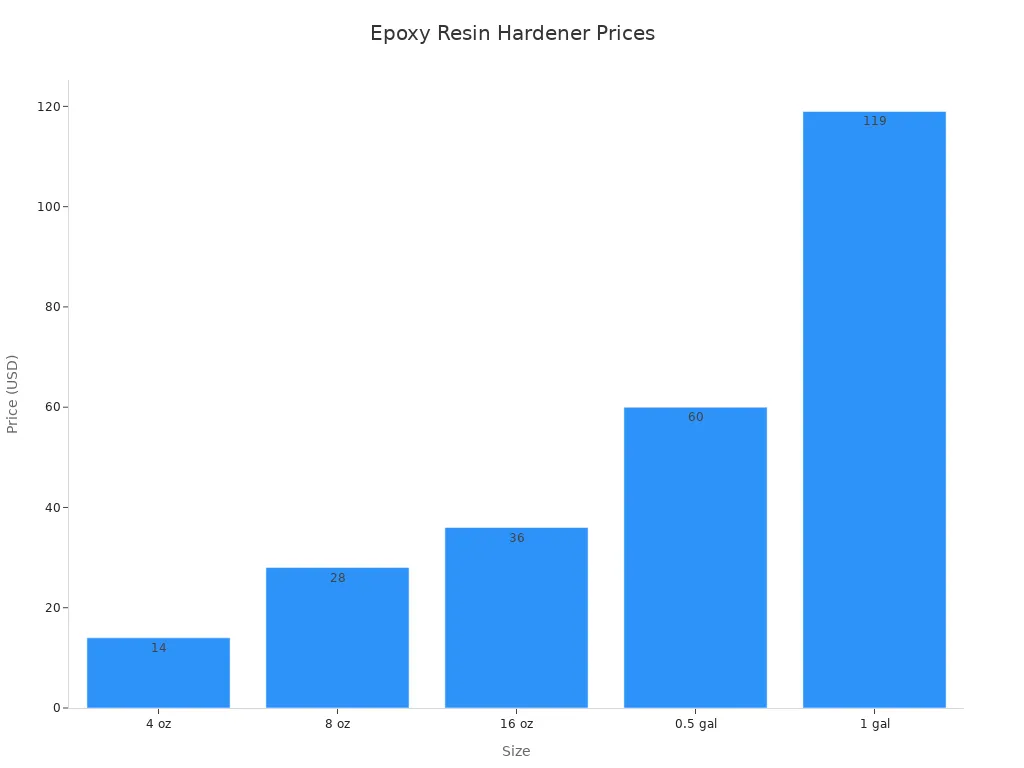
The sticker price on a resin gallon tells only part of the story. Every epoxy resin system requires a matching hardener to cure properly. Many manufacturers sell the hardener separately. That component can add 20% to 30% to your total cost. You cannot skip it or substitute another brand's hardener. The chemistry must match exactly.
Size | Price (USD) |
|---|---|
4 oz | $14 |
8 oz | $28 |
16 oz | $36 |
0.5 gal | $60 |
1 gal | $119 |
The hardener is the most expensive part of the kit. Some bargain brands cut corners on this component to lower their price. Weak hardeners lead to "bendy" resin that never fully cures. You save money upfront but waste the entire project when the surface stays soft and tacky.
Beyond the resin and hardener, you need supplies. Mixing cups, stir sticks, and gloves cost about $10. A heat gun for removing bubbles adds another $15 to $40. These items push your project budget $20 to $50 higher before you even open the resin container. Plan for these costs when you calculate your total investment.
How to Get the Best Value for Your Epoxy Resin
Buying in Bulk and Checking Shelf Life
Buying larger quantities directly lowers your cost per gallon. Manufacturers offer volume discounts on bulk orders, and the unit price drops as the kit size grows. For example, a 10-gallon bulk kit from ArtResin costs $759. That works out to $75.90 per gallon. Compare that to buying single gallons, which often cost $80 to $100 each. The savings become significant when you have a large project planned.
But bulk buying only makes sense if you can use the material before it expires. Most epoxy systems last 12 to 36 months when stored properly. You need to keep them in a cool, dry place between 60°F and 80°F. Temperatures below 50°F risk crystallization, while above 90°F can trigger premature curing. The Ar-100 Epoxy has a shelf life of just 12 months, so always check the manufacturer label.
To avoid waste, follow a simple system. Track the production date, not just the purchase date. Use the FIFO rule: First In, First Out. Store resin and hardener separately to prevent moisture damage. Keep containers sealed, upright, and away from UV light. And most importantly, only buy what you can realistically use within the shelf-life window. Bulk buying is cost-effective only when you manage storage properly.
Reading Reviews and Understanding Pot Life
Pot life determines how long you can work with the mixed epoxy resin before it hardens. Short pot life means you must work fast. Beginners often struggle with this, leading to rushed applications and wasted material. Longer pot life gives you more time to spread, position, and finish your work.
Reading reviews helps you choose the right pot life for your skill level. Experienced users often mention whether a resin sets too quickly or stays workable long enough. You can learn from their mistakes without making them yourself. The right pot life balances production speed with bond quality. You prevent rushed applications that compromise the final result.
Pot life also affects waste directly. If you mix more resin than you can use within the working time, the excess hardens in the cup. That material becomes trash. By calculating your needs based on pot life, you minimize unused resin. You also catch mixing ratio errors early, reducing rework costs. Choose a resin with a pot life that matches your pace. You will save money and get better results.
The cost of a gallon of epoxy resin is not a single number. It's a range influenced by type, quality, and where you shop. You now understand the difference between tabletop and deep pour formulas. You know why premium brands charge more for UV resistance and reliability.
Don't buy a deep pour resin for a thin tabletop coat. You'll waste money and get poor results. Match the product to your specific project thickness.
Remember that the sticker price is just the beginning. Factor in the hardener and supplies. Those extras add 20% to 50% to your total budget.
Now you can confidently compare options. Choose the right epoxy resin for your next project without overspending. Your research will pay off in quality results.
FAQ
How much epoxy resin do I need for my project?
Calculate your project's surface area in square feet. Divide that number by the coverage per gallon at your desired thickness. For example, a 1/8-inch tabletop layer covers about 8 square feet per gallon. A 4-foot by 2-foot tabletop needs roughly one full gallon.
Can I use tabletop resin for deep pours?
No. Tabletop resin works only for layers 1/8 inch or thinner. Deep pours require specialized casting resin that prevents overheating and cracking. Using the wrong type risks clouding, bubbles, and failed projects. Match the resin type to your project's thickness before purchasing.
Why does hardener cost extra?
Most manufacturers sell resin and hardener separately. The hardener contains the chemical catalyst that triggers curing. It typically adds 20% to 30% to your total cost. You cannot substitute another brand's hardener because the chemistry must match exactly for proper results.
Is buying in bulk always cheaper?
Bulk kits lower your per-gallon price significantly. A 10-gallon kit costs about $75.90 per gallon compared to $80-$100 for single gallons. However, most epoxy lasts only 12 to 36 months. Only buy in bulk if you can use the material before it expires.
How do I avoid wasting epoxy resin?
Mix only what you can use within the pot life. Short pot life means the resin hardens quickly in the cup. Beginners should choose resins with longer working times. Read reviews to learn how fast each product sets before you commit to a purchase.