How does sheet moulding compound improve automotive parts performance and lightweight design
Modern automotive manufacturing demands lighter vehicles without compromising passenger safety. Sheet molding compound leads this transformation as a high-performance, fiber-reinforced thermoset material. This advanced composite delivers low density, exceptional structural strength, and outstanding corrosion resistance. Automotive engineers utilize sheet molding compound to consolidate multiple structural parts into single molded components. Consequently, OEMs optimize vehicle mass, streamline high-volume automated manufacturing, and unlock superior design flexibility.
Key Takeaway: Thermoset composites offer lightweight performance, structural integrity, and manufacturing efficiency for next-generation vehicle designs.
Key Takeaways
Sheet molding compound cuts vehicle weight by up to 75 percent compared to steel.
Lighter car parts help electric vehicles drive up to five percent farther on a single charge.
Engineers mold complex shapes into single strong parts to lower assembly costs.
Fire-resistant composite materials keep electric vehicle battery enclosures safe and stable under extreme heat.
Performance Advantages of Sheet Molding Compound
Modern vehicle architectures require materials that combine lightweight characteristics with unyielding structural integrity. High-performance composite formulations deliver this balance across demanding automotive applications.
Structural Strength and Impact Resistance
Advanced thermoset formulations incorporate extended fiber reinforcement between 18% and 60% fiberglass or carbon fiber. These long fibers form a dense internal matrix during compression molding. The resulting network distributes mechanical stress efficiently across the component geometry. Automotive structural parts achieve impressive mechanical properties through this reinforced network:
Weight Reduction: External automotive panels utilize sheet molding compound to reduce total component weight by up to 30% compared to traditional steel.
Thermal Endurance: Underhood structural components withstand continuous operational engine bay environments up to 204°C.
Superior Tensile Strength: Composite materials reach tensile capacities up to 85 MPa, outperforming standard automotive thermoplastics like polypropylene and ABS.
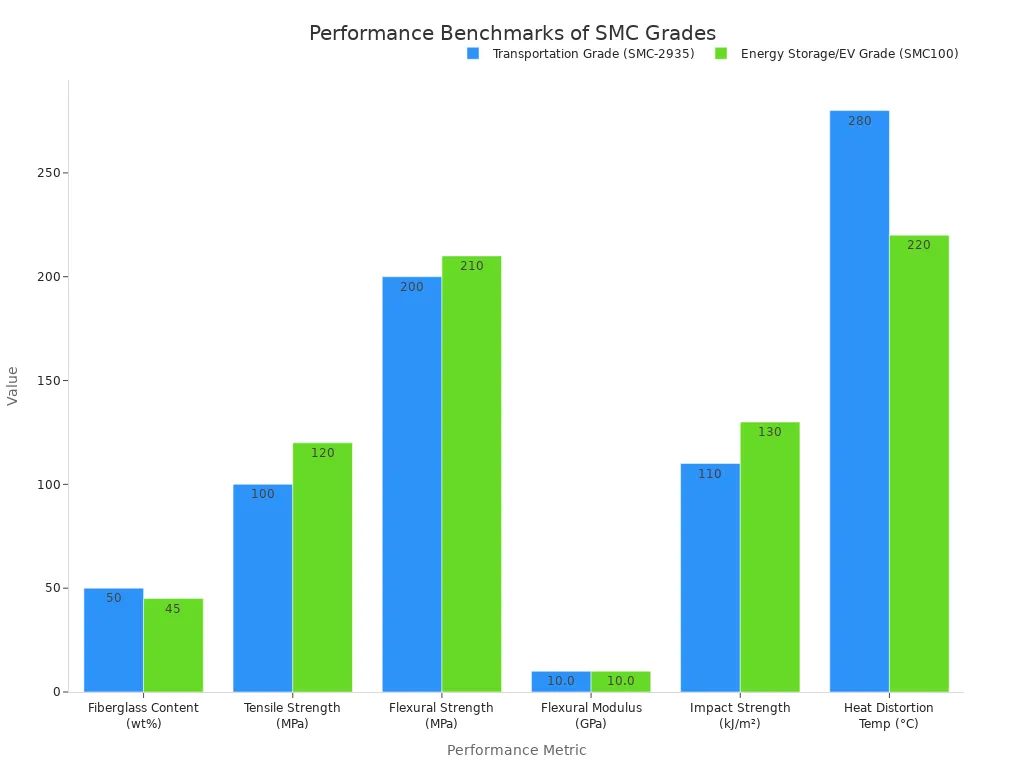
Engineers select specific composite formulations based on target structural roles. Union Composites supplies tailored grades with extended fiber lengths to maximize impact resistance and load-bearing capacities. The table below details key performance benchmarks for transportation and energy storage grades:
Metric Benchmark | Transportation Grade (SMC-2935) | Energy Storage/EV Grade (SMC100) |
|---|---|---|
Fiberglass Content (wt%) | 50% | 45% |
Tensile Strength (MPa) | ≥ 100 | ≥ 120 |
Flexural Strength (MPa) | ≥ 200 | ≥ 210 |
Flexural Modulus (GPa) | ≥ 10.0 | ≥ 10.0 |
Impact Strength (kJ/m²) | ≥ 110 | ≥ 130 |
Heat Distortion Temp (°C) | ≥ 280 | ≥ 220 |
The following chart illustrates these structural metrics across specialized material formulations:
Thermal Stability and Chemical Protection
Automotive parts encounter harsh chemicals, intense sunlight, and high thermal loads throughout their operational lifespan. Thermoset composite materials offer inherent resistance against acids, alkalis, and UV radiation. Unlike metals, these non-corrosive materials prevent oxidation and environmental degradation over time.
Safety Standard Compliance: Electric vehicle battery enclosures made from sheet molding compound satisfy strict UL94 V-0 flame retardancy requirements. These fire-resistant housings act as robust thermal barriers, containing internal heat events and protecting passenger compartments.
High thermal stability prevents thermal expansion issues during operation. Components retain their geometric shape even near hot powertrain elements or high-voltage battery modules.
High-Precision Class A Surface Finish
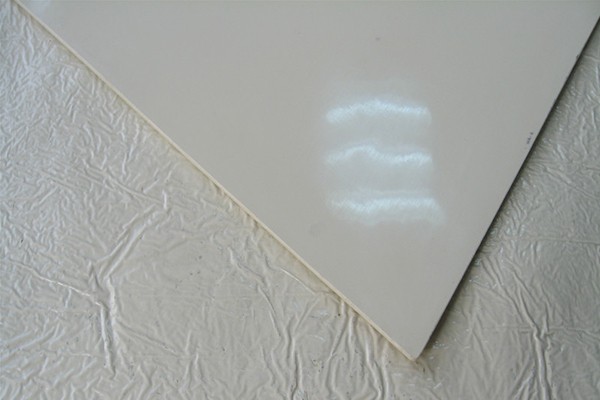
Exterior body panels demand mirror-flat aesthetic surfaces. Standard unsaturated polyester resins experience volumetric shrinkage during heat polymerization, creating surface flaws. Advanced composite formulations eliminate these flaws through specialized low-shrinkage curing additives.
Stage / Factor | Mechanism & Effects | Impact on Finish |
|---|---|---|
Uncured/Standard Cure | Resin contracts 5–8% by volume as double bonds turn into single bonds during polymerization. | Causes surface waviness, sink marks, and fiber readthrough. |
Phase Separation Mechanism | Additives like polystyrene or PVAc start out miscible but separate into distinct domains as crosslinking occurs. | Generates internal microvoids that offset volumetric shrinkage. |
Class A Quality Outcome | Controlled phase domains neutralize macroscopic volume changes. | Yields a mirror-flat, void-free surface ready for painting. |
Low-shrinkage curing guarantees zero-defect dimensional precision. Molded fenders, door skins, and hood covers exit the tool with smooth Class A surfaces ready for standard automotive paint lines.
Lightweight Design and Efficiency Gains
Automotive manufacturers continuously search for advanced materials to replace heavy metal components. Sheet molding compound provides an ideal solution by reducing total vehicle mass while preserving structural strength.
Density Reduction and Vehicle Mass Optimization
Density plays a critical role in automotive mass optimization. Sheet molding compound features a significantly lower specific gravity than conventional structural metals:
Traditional Steel: 7.85 g/cm³
Automotive Aluminum: 2.70 g/cm³
Thermoset Composite SMC: 1.80 g/cm³
Material Fact: Thermoset composites weigh approximately 30% less than aluminum and 75% less than steel. This dramatic density advantage allows engineers to replace thick metal stampings without sacrificing component rigidity.
The table below illustrates structural mass savings across standard automotive assembly parts:
Component Type | Metal Mass (kg) | Composite Mass (kg) | Total Weight Savings (%) |
|---|---|---|---|
Tailgate Assembly | 14.5 | 9.2 | 36.5% |
Engine Valve Cover | 3.8 | 2.1 | 44.7% |
EV Battery Enclosure Tray | 45.0 | 28.5 | 36.6% |
EV Driving Range and Efficiency Enhancement
Vehicle weight directly dictates energy consumption. Heavy vehicles require more force during acceleration, ascending hills, and cornering. Weight reduction yields immediate efficiency gains across both internal combustion engine (ICE) vehicles and electric vehicles (EVs).
Mass Reduction ️ Lower Energy Demand ️ Extended EV Battery Range / Lower Fuel Use
ICE Fuel Economy: A 10% reduction in vehicle weight improves fuel economy by roughly 6% to 8%. Lower mass reduces engine strain and lowers tailpipe emissions.
EV Driving Range: Lower vehicle mass directly extends battery performance. Every 100 kg of eliminated mass increases electric driving range by approximately 3% to 5%.
Secondary Savings: Lighter vehicle bodies allow engineers to downsize braking systems, suspension components, and electric motors.
Optimized Wall Thickness and Material Use
Precision compression molding eliminates redundant material. Traditional sheet metal stamping requires uniform sheet thickness across the entire part geometry. In contrast, thermoset molding allows variable wall thickness within a single component.
Union Composites utilizes Industry 4.0 dark factory automation during material compounding. Automated production lines control fiber distribution and resin viscosity with extreme accuracy. This strict quality control yields several key production advantages:
Uniform Material Flow: Mold cavities fill evenly without creating fiber-starved zones.
Targeted Rib Reinforcement: Engineers add local rib structures only where load stress demands reinforcement.
Tight Tolerances: Automated chemical dosing guarantees consistent wall thickness across high-volume production runs.
These advanced automated processes prevent material waste and maximize load-bearing efficiency. Automotive OEMs achieve lighter component designs without risking structural failure under road stress.
Design Flexibility and Part Integration
Thermoset composite technology gives vehicle designers freedom to create innovative, aerodynamic shapes. Precision compression molding forms complex shapes that traditional metal stamping cannot replicate.
Complex Geometry Molding
Automotive engineers design detailed structural geometries with varying wall thicknesses in a single molding step. High-pressure compression molds press composite charges into exact shapes without creating internal stress points. Single-step sheet molding compound process directly integrates critical functional elements:
Ribs: Molded features enhance structural stiffness and flexural strength without adding excessive weight.
Bosses: Integrated attachment hubs provide solid mounting points for threaded fasteners.
Inserts: Embedded metallic components establish reinforced functional joints during the primary molding cycle.
Component Consolidation and Assembly Savings
High moldability transforms traditional multi-piece metal assemblies into single composite structures. Engineers combine separate brackets, housings, and reinforcement plates into one unified part.
Efficiency Advantage: Consolidating parts eliminates mechanical fasteners, spot welds, and manual joining operations.
Component integration delivers clear financial and operational benefits across vehicle production lines:
Part Consolidation: Complex geometric capability allows manufacturers to merge multiple individual steel stampings into a single composite structure.
Reduced Assembly Steps: Producing fewer distinct parts directly eliminates intermediate joining processes and lowers total labor costs.
Multifunctional Integration: Building wiring channels, airflow paths, and mounting tabs into structural components minimizes the need for auxiliary tooling.
Cost-Effective High-Volume Manufacturing
Automated manufacturing plants process compression molded parts rapidly to meet strict automotive cycle targets. Contemporary compression molding technology utilizing composite materials enables rapid manufacturing processes for vehicle parts, successfully reducing cycle times to a range of 60 to 90 seconds.
Union Composites utilizes dark factory automation to control material dosing, mold temperature, and press cycle speed. Automated press lines deliver repeatable part dimensions across massive production runs. Lower tooling wear, minimal raw material scrap, and fast cycle times maximize long-term profitability for automotive original equipment manufacturers.
Sheet molding compound empowers automotive engineers to achieve significant mass reduction without sacrificing structural strength or passenger safety. This advanced composite combines high mechanical performance, mirror-smooth Class A surface finishes, and streamlined assembly through part consolidation.
Future Driving Force: As the automotive industry accelerates toward electric mobility, high-performance sheet molding compound will continue driving the evolution of lightweight, energy-efficient vehicles.
FAQ
What is Sheet Molding Compound (SMC) in automotive design?
Sheet Molding Compound (SMC) is a high-performance thermoset composite material. It combines unsaturated resin, chopped fiberglass or carbon fibers, and mineral fillers. Automotive engineers use SMC to replace heavy steel components, significantly reducing total vehicle mass while maintaining superior structural strength.
How does SMC help electric vehicles extend driving range?
SMC drastically reduces vehicle mass compared to traditional steel and aluminum. Lighter vehicles consume less battery energy during operation.
Range Fact: Every 100 kg of mass eliminated through lightweight composite materials increases electric vehicle driving range by 3% to 5%.
Can SMC body panels achieve a Class A surface finish?
Yes. Advanced SMC formulations utilize low-shrinkage curing technology to prevent surface defects during thermal polymerization. Molded composite panels exit the tool with smooth, mirror-flat Class A surfaces. Consequently, these exterior parts transition directly into standard automotive paint lines.
Is SMC safe for high-temperature EV battery enclosures?
Yes. Specially engineered SMC formulations satisfy strict UL94 V-0 flame retardancy requirements. These fire-resistant thermoset composites act as thermal barriers during battery heat events. They protect passenger compartments from fire hazards while offering complete protection against road salts and corrosive chemicals.