Why is sheet moulding compound widely used in electrical insulation and equipment manufacturing
You want electrical equipment that stays safe and lasts a long time. Sheet moulding compound gives you this advantage. Many companies choose this material because it resists heat, fire, and corrosion. The table below shows why you can trust it for insulation and equipment:
Property | Description |
|---|---|
Non-conductive nature | Keeps you safe by stopping electrical flow. |
Excellent arc resistance | Handles high voltage without sparking. |
High mechanical strength | Makes your equipment strong and reliable. |
Dimensional stability | Keeps its shape, even in changing temperatures. |
Resistance to corrosion | Works well outdoors and in tough places. |
UV resistance | Stops fading and breaking in sunlight. |
Flame retardancy | Helps stop fires before they spread. |
Heat resistance | Works in high-heat situations up to 180 °C. |
Sheet moulding compound now makes up 28% of the global market for electrical insulation and equipment.
Insulators made from this material account for 17% of total demand.
In 2024, the electrical sector saw a 28% rise in its use.
Union Composites leads the way with top-quality products and constant innovation. You get reliable solutions designed for your needs.
Key Takeaways
Sheet moulding compound (SMC) is non-conductive, providing strong electrical insulation to keep equipment safe.
SMC resists heat, fire, and corrosion, making it ideal for outdoor and harsh environments.
The lightweight nature of SMC allows for easier handling and installation, while offering design flexibility.
SMC has high mechanical strength, reducing the need for repairs and ensuring long-lasting performance.
Union Composites offers customizable SMC products, allowing you to get exactly what you need for your projects.
SMC Properties for Electrical Insulation
Electrical Insulation Performance
You need electrical insulation that keeps you safe and your equipment working. Sheet moulding compound gives you strong protection because it does not conduct electricity. Union Composites uses fiberglass reinforcement and high-performance resins in every product. These materials help the compound block electrical flow and keep your devices safe.
Fiberglass reinforcement adds strength and stiffness.
High-performance resins boost insulation properties.
The compound stays strong even in humid conditions.
It does not let electricity pass through, so you stay safe.
You can see how well sheet moulding compound performs compared to other materials:
Property | Bulk Molding Compound (BMC) | Sheet Molding Compound (SMC) |
|---|---|---|
Dielectric Strength | 12 – 20 kV/mm | 10 – 18 kV/mm |
This high dielectric strength means your equipment can handle high voltages without breaking down. The compound also resists tracking and arcing, which protects sensitive parts like busbars and insulators. Because it keeps its shape and size, you get reliable performance in every use.
Note: The dimensional stability of sheet moulding compound helps your electrical systems work well, even when exposed to moisture, dust, or UV light.
Thermal and Flame Resistance
You want your electrical equipment to resist heat and fire. Sheet moulding compound stands out because it can handle high temperatures and stop flames from spreading. Union Composites designs its products to work in hot environments, up to 180°C.
The compound passes strict flame resistance tests. The table below shows how it performs:
Fire Retardancy | Limited Oxygen Index (%) |
|---|---|
2.5mm, V0 | ≥36 |
3.0mm, V0 | ≥35 |
4.0mm, V0 | ≥32 |
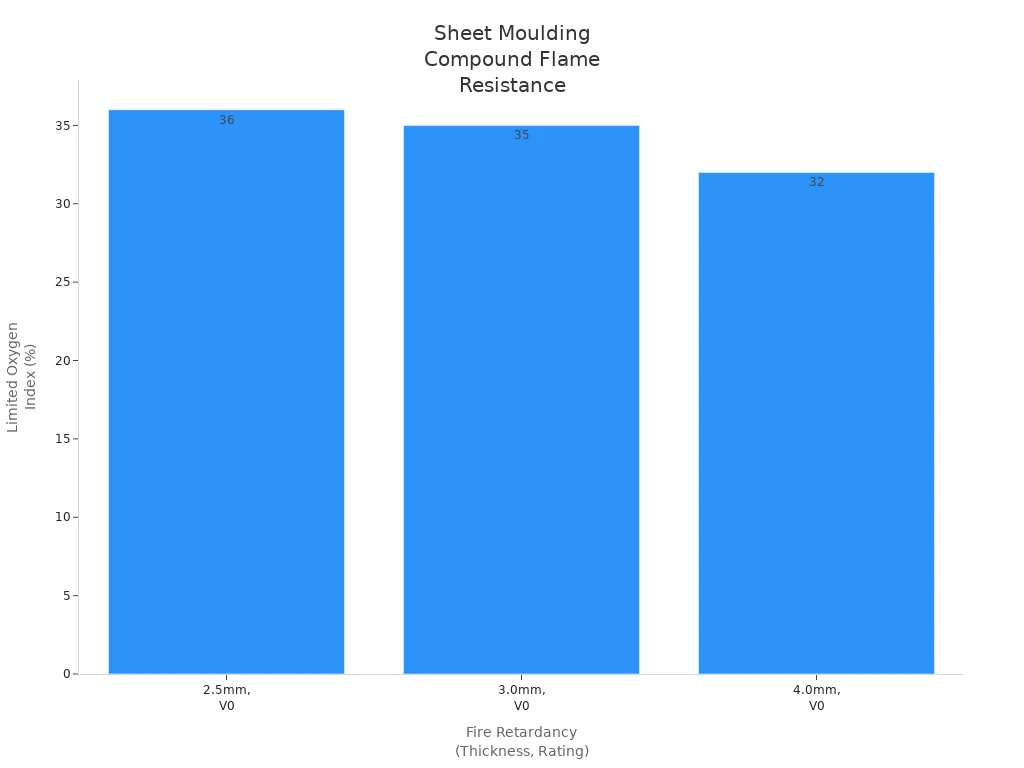
These results mean your equipment will not catch fire easily. The compound keeps its strength and shape, even when exposed to heat or flames. This makes it a safe choice for electrical enclosures and panels.
Chemical and Corrosion Resistance
You need materials that last, even in tough environments. Sheet moulding compound resists many chemicals and does not corrode. Union Composites engineers its products to stand up to oils, fuels, and harsh chemicals found in factories and power plants.
Application | Chemical Resistance Properties |
|---|---|
Automotive oil pans and valve covers | Good resistance to oils and fuels |
Industrial housings and enclosures | Suitable for exposure to various industrial chemicals |
Energy sector components | Engineered for chemical resistance in demanding environments |
Protective panels and covers | Designed for use in chemical environments |
The compound’s special formula prevents it from breaking down in harsh conditions. This means your electrical equipment stays strong and works longer, even outdoors or in places with lots of moisture or chemicals.
Tip: The corrosion resistance of sheet moulding compound helps your equipment last longer and keeps it working safely over time.
Sheet Moulding Compound Advantages in Manufacturing
Mechanical Strength and Durability
You want your electrical equipment to last and stay strong. Sheet moulding compound gives you high mechanical strength. This means your parts can handle heavy loads and tough conditions. Union Composites uses fiberglass and strong resins to make sure every product meets strict standards.
Take a look at how sheet moulding compound compares to other materials:
Material Type | Flexural Strength (MPa) | |
|---|---|---|
Sheet Moulding Compound (SMC) | 50–125 | 120–230 |
Aluminum Alloys | Comparable | N/A |
You can see that SMC matches or even beats metals in strength. This helps your equipment resist cracks and breaks. The durability of SMC also means you spend less time and money on repairs. Because it keeps its shape and strength, your equipment works longer and needs less maintenance. You get more reliable performance every day.
Tip: Strong and durable materials help you avoid costly downtime and keep your systems running smoothly.
Lightweight and Design Flexibility
You need materials that are easy to handle and shape. Sheet moulding compound is much lighter than metal. This makes it easier for you to move and install parts. You also get more freedom in design. SMC can be molded into complex shapes that other materials cannot match.
Here is what you can achieve with SMC:
Feature | Benefit for You |
|---|---|
Complex shapes | Create detailed and unique designs |
Consistent quality | Get the same results every time |
Less material waste | Save resources and reduce costs |
Union Composites uses advanced machines and Industry 4.0 technology. This means you get parts with precise shapes and smooth surfaces. You can ask for custom colors, sizes, or special features. The team at Union Composites will help you design the perfect part for your needs.
Cost Optimization and Quality Control
You want to save money without losing quality. Union Composites has its own production line. This helps keep prices low and quality high. The company uses smart technology to check every batch. You get products that meet your standards every time.
Here is how you benefit:
Lower production costs mean better prices for you.
Free samples let you test the product before you buy.
Customization options help you get exactly what you need.
Strict quality checks ensure every part works as promised.
Note: When you choose Union Composites, you get reliable products, expert support, and the chance to try before you buy.
Applications of SMC in Electrical Equipment
Common Electrical Components
You see sheet moulding compound used in many electrical products. Manufacturers choose this material for items like switchgear housings, meter boxes, and circuit breaker panels. You also find it in cable trays, junction boxes, and transformer covers. These parts need to stay strong and safe, even when exposed to heat, moisture, or chemicals.
Here is how SMC improves the performance of electrical housings and enclosures:
Feature | Benefit for Your Equipment |
|---|---|
Excellent mechanical properties | Makes housings durable and strong |
Superior surface quality | Gives a smooth, attractive finish |
Cost efficiency | Lowers production costs |
Automated compression molding compatibility | Ensures consistent quality |
Stable mechanical and dimensional behavior | Keeps shape in different conditions |
Reduced labor and production variability | Streamlines manufacturing |
Metal replacement capability | Offers lightweight, corrosion-resistant options |
You get products that last longer and look better. SMC also helps you save money and get reliable results every time.
Real-World Examples and Case Studies
You can find SMC electrical components in homes, factories, and power stations around the world. For example, many companies use SMC to make outdoor electrical enclosures that resist rain and sunlight. In busy factories, SMC panels protect sensitive controls from dust and chemicals.
Union Composites supplies these solutions to customers in Europe, Asia, America, the Middle East, and Africa. Their team works with you to create custom parts for your needs. You might need a special color or a unique shape. Union Composites can help you design and produce it.
Tip: When you choose SMC from Union Composites, you get products trusted by industries worldwide. You also benefit from their experience and support at every step.
SMC Compared to Alternative Materials
SMC vs. Thermoplastics
You want materials that protect your electrical equipment and keep it safe. Sheet moulding compound (SMC) gives you better insulation than most thermoplastics. SMC does not let electricity pass through, so your devices stay safe. Thermoplastics can melt or deform when exposed to high heat. SMC stays strong and keeps its shape, even in hot environments.
You also get a smoother surface finish with SMC. This makes your parts look better and helps them fit together perfectly. Union Composites uses advanced molding technology to give you consistent quality. You can choose custom colors and shapes for your equipment. SMC also resists chemicals and moisture, so your parts last longer.
Tip: SMC helps you reduce maintenance costs because it does not crack or break easily.
SMC vs. Metals
You need materials that last and perform well in tough conditions. SMC outperforms metals in many ways. Metals can rust or corrode when exposed to moisture or chemicals. SMC resists corrosion and keeps your equipment working longer. You also get lighter parts with SMC, which makes installation easier.
Take a look at how SMC compares to metals:
Feature | SMC Advantages |
|---|---|
Weight | Lightweight structures |
Corrosion Resistance | Excellent chemical resistance |
Electrical Insulation | Nonconductive materials suitable for electrical use |
Mechanical Performance | Metal-like strength and stability without weight |
SMC gives you more design flexibility. You can create complex shapes that metals cannot match. This helps you build better housings and enclosures for electrical equipment. SMC also provides excellent insulation and flame retardancy. These properties keep your systems safe in high-voltage and hazardous environments.
SMC materials are used in electrical cabinets and switchgear housings.
You find SMC in automotive body panels and industrial housings.
SMC is ideal for sanitary ware and construction panels.
Note: SMC from Union Composites gives you reliable performance and a smooth finish, even in demanding conditions.
You see why sheet moulding compound stands out in electrical insulation and equipment manufacturing. You get many benefits, such as:
High mechanical strength and stiffness
Low shrinkage and excellent dimensional stability
Good surface finish for visible parts
Resistance to corrosion and chemicals
Reliable fire performance and electrical insulation
Lightweight design
You can trust Union Composites for high-quality solutions that help your equipment last longer and perform better.
FAQ
What makes SMC a good choice for electrical insulation?
You get strong electrical insulation with SMC. The material blocks electricity and resists high voltage. It keeps your equipment safe and reliable.
Can SMC parts handle outdoor conditions?
Yes. SMC resists UV rays, moisture, and corrosion. You can use it for outdoor electrical enclosures and panels. Your equipment stays protected in harsh weather.
How does SMC compare to metal for electrical equipment?
SMC weighs less than metal and does not rust. You get easier installation and longer-lasting parts. SMC also insulates against electricity, which metal cannot do.
Can I customize SMC products for my project?
Yes! Union Composites offers custom colors, sizes, and shapes. You can request free samples to test before you buy. Their team helps you find the best solution for your needs.