How long does it take for epoxy resin to dry
Epoxy resin, a versatile thermosetting polymer widely used in crafts, construction, and industrial manufacturing, offers exceptional durability and adhesive properties. However, one of the most frequently asked questions by users is: How long does it take for epoxy resin to dry? The answer depends on multiple factors, including resin type, curing agents, environmental conditions, and project specifications. This article explores the drying dynamics of epoxy resin and provides practical insights for optimizing curing times.
Key Factors Influencing Drying Time
1.Type of Curing Agent
Epoxy resin typically requires a hardener (curing agent) to initiate polymerization. Common hardeners include polyethylene polyamine (PEPA) and triethylene tetramine (TETA), each with distinct curing characteristics:
PEPA (Cold-Curing Agent): Ideal for room-temperature applications, PEPA-based epoxy resin takes 24 hours to fully cure under standard conditions (20–25°C). It offers excellent heat resistance (up to 400°C post-curing) but may yellow over time if exposed to prolonged UV light.
TETA (Heat-Accelerated Agent): TETA requires elevated temperatures (up to 50°C) to accelerate curing, reducing drying time to 5–6 hours for small batches. However, improper temperature control can cause internal bubbling, especially in thick castings.
For example, a 100-gram epoxy mixture using PEPA may harden in 12–24 hours at room temperature, while TETA-based resin achieves the same result in 6–8 hours when heated to 50°C.
2.Environmental Conditions
Temperature and humidity significantly impact curing speed:
Temperature: Each 10°C increase in ambient temperature can triple the curing rate. For instance, reducing the temperature from 25°C to 15°C extends the minimum drying time of PEPA-based resin from 30 minutes to 80 minutes.
Humidity: High humidity (above 70%) may slow curing by introducing moisture, which interferes with polymerization. Conversely, low humidity (below 40%) is optimal for UV-cured resins, which rely on dry air to prevent surface tackiness.
3.Resin Thickness and Volume
Thicker layers generate more heat through exothermic reactions, accelerating curing but risking cracking if not managed properly:
Thin Layers (<2 mm): Cure uniformly in 12–24 hours at room temperature, depending on the hardener.
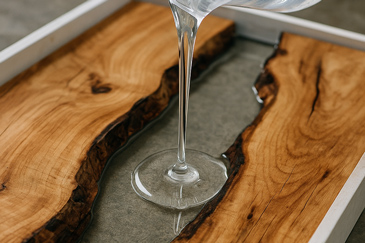
Thick Castings (>5 cm): Require staged pouring to prevent overheating. For example, a river table made with TETA-based resin may need 3–5 days of incremental pouring to achieve full hardness.
4.Additives and Fillers
Incorporating pigments, glitter, or metallic powders can alter curing dynamics:
Fast-Curing Additives: Iron or aluminum fillers act as catalysts, reducing drying time by 30–50%.
UV Stabilizers: Delays yellowing but may extend curing by 10–20% in sunlight-exposed applications.
Accelerating Drying Time: Practical Tips
Heat Application: Use a heat gun or space heater to raise the ambient temperature to 30–35°C, reducing curing time by 40–60% for PEPA-based resins. Avoid exceeding 50°C to prevent bubbling.
UV Light Exposure: For UV-cured epoxy (e.g., jewelry coatings), a 365 nm UV lamp can harden a 1-mm layer in 2–5 minutes, though thicker layers require longer exposure.
Optimized Mixing Ratios: Strictly adhere to manufacturer guidelines (e.g., 2:1 or 1:1 by weight). Excess hardener may cause incomplete curing or brittleness.
Pre-Heating Components: Warming resin and hardener to 30°C before mixing enhances flow and reduces viscosity, aiding uniform curing.
Industry-Specific Considerations
Crafts and Jewelry: Clear epoxy resins (e.g., ALD-2103) cure in 24–26 hours at 25°C, with UV-resistant formulations maintaining clarity for 12+ months.
Industrial Coatings: Fast-dry AB glues (e.g., 5-minute epoxy) achieve handling strength in 5–10 minutes but require 24 hours for full mechanical properties.
Construction: Floor coatings using TETA-based resin may take 7–14 days to reach maximum hardness due to their thickness.
Conclusion
The drying time of epoxy resin is a multifaceted variable influenced by curing agents, environmental factors, and project requirements. While PEPA-based resins offer simplicity and heat resistance for general applications, TETA and UV-cured variants provide speed for time-sensitive projects. By controlling temperature, thickness, and additives, users can tailor epoxy resin’s curing behavior to their needs. Whether crafting delicate jewelry or constructing durable industrial coatings, understanding these dynamics ensures optimal results and maximizes the material’s versatility. Epoxy resin remains a cornerstone of modern manufacturing, and mastering its drying process unlocks its full potential across industries.